The global labor market is undergoing a profound transformation. Out of a global workforce of 3.38 billion, roughly 1.57 billion people are now engaged in freelance or independent work. Within this massive shift, Southeast Asia has emerged as the primary engine of digital labor, providing specialized skills to corporations across the United States, the UK, and Europe.
However, while the labor market has become truly borderless, the financial infrastructure supporting it remains stuck in the past. Today, we are thrilled to announce a new partnership between Noah and Hurupay to completely eliminate the friction, hidden fees, and delays of legacy cross-border payments for freelancers in emerging markets.
Southeast Asia's Transition to Digital Informality
To understand the urgent need for a new payment rail, we have to look at the sheer scale of the remote work economy in the Philippines and Indonesia. These are not marginal sub-sectors; they are primary drivers of national GDP.
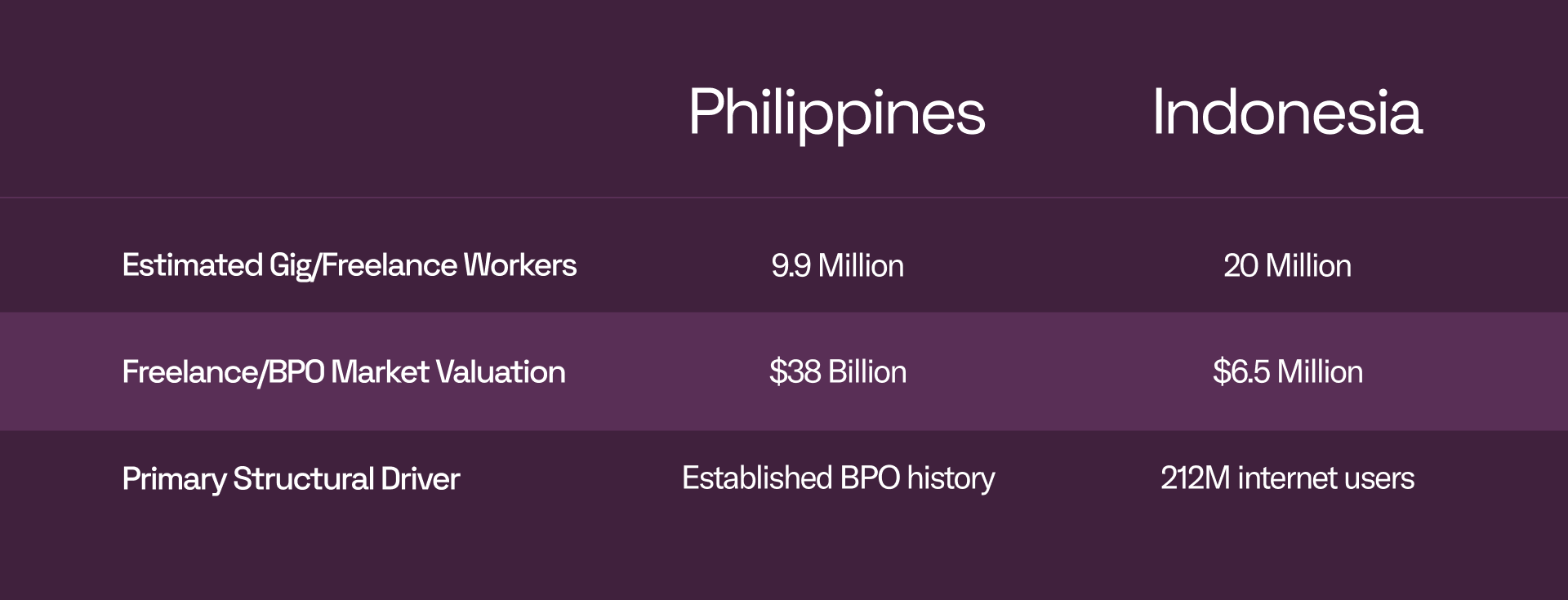
In Indonesia, the gig economy represents a unique transition from traditional informal labor to "semi-formal" digital work. Driven by an internet user base of 212 million people, the country's freelance platform market reached a valuation of $6.50 billion in 2023, encompassing an estimated 20 million gig workers.
Meanwhile, the Philippines has long been a global powerhouse for Business Process Outsourcing (BPO), an industry that generated $38 billion in revenue in 2024. This foundation has paved the way for nearly 9.9 million Filipinos to participate in the gig economy.
The Toll of Legacy Finance: Billions Lost to Hidden Fees
Despite the scale of this workforce, freelancers frequently encounter significant inefficiencies within the traditional correspondent banking system. When an international client initiates a payment, funds are often routed through multiple intermediary institutions before reaching the recipient. Each intermediary can introduce additional processing delays, transfer fees, and foreign exchange markups. The cumulative economic impact of these inefficiencies is substantial.
In 2023 alone, Filipino workers are estimated to have lost approximately PHP 8.37 billion due to hidden foreign exchange fees. In Indonesia, independent research indicates that citizens collectively incur up to Rp 15.09 trillion annually in cross-border transaction costs and exchange rate margins.
A seemingly straightforward solution would be for freelancers to receive and hold their earnings directly in US dollars, thereby avoiding repeated currency conversions. However, significant barriers exist.
Opening a US bank account as a non-resident typically requires a US physical address, a Social Security Number or Employer Identification Number, and in many cases in-person verification at a branch location. For freelancers based in Southeast Asia, these requirements render US banking largely inaccessible.
Local alternatives offer limited relief. Opening a USD-denominated account at a domestic bank in Indonesia or the Philippines frequently requires minimum deposits between $100 and $500, as well as strict monthly balance requirements and extensive documentation procedures.
Furthermore, these accounts often cannot receive direct domestic transfers from US banks. Instead, payments must be processed through the SWIFT network, which introduces intermediary fees and settlement timelines that may extend for several days or longer.
For many freelancers, these constraints effectively prevent access to efficient USD banking services.
The Solution: Noah and Hurupay Join Forces
To address this structural limitation, Noah and Hurupay have partnered to deliver institutional-grade financial infrastructure directly to freelancers via their smartphones.
By integrating Noah's enterprise-grade API infrastructure, Hurupay is able to provide freelancers in Indonesia, the Philippines, and beyond with unique, named virtual USD and EUR bank accounts.
How the integration works:
- Frictionless Corporate Payroll: A freelancer provides their U.S. or European client with their Hurupay virtual account details. The employer simply executes a standard, free domestic bank transfer (like an ACH, SEPA, SWIFT, or Wire). The employer doesn't need to interact with cryptocurrency at all.
- Stablecoin Conversion via Noah: Once the fiat funds arrive, Noah's backend engine automatically converts the local currency into a stablecoin (like USDC or USDT) at real-time, mid-market exchange rates.
- Instant Wallet Settlement: The minted stablecoins are instantly pushed to the user's non-custodial Hurupay wallet.
This symbiotic workflow is revolutionary. Hurupay users can open these accounts completely free of charge, with zero minimum deposit requirements and a transparent, flat receiving fee of just 1% to 2%.
By holding stablecoin as digital dollars, freelancers are entirely insulated from the macroeconomic depreciation of their local currencies. When they are ready to use their funds, they can issue virtual USD cards to pay for global subscriptions, or withdraw their stablecoins directly to local banking rails and mobile money wallets (like GCash or GoPay) at highly competitive peer-to-peer exchange rates.
Through this partnership, Noah and Hurupay are not just offering an alternative payment method; we are fundamentally reshaping the mechanics of global financial inclusion and putting billions of dollars back into the pockets of the digital workforce. Since launch, 1 year ago, Hurupay has already processed $55M in volume and onboarded over 35k users across Asia—and with Noah's infrastructure, this movement is ready to scale even further.